





Robotic Rehabilitation
What is Robotic Rehabilitation?
Robotic rehabilitation systems can be used in neurological conditions that cause gait disorders, in patients with balance problems and in any condition that leads to a loss of walking function.
As technology has advanced, robotic rehabilitation systems have found their place in rehabilitation. They can be used in any condition that makes walking difficult. In the rehabilitation of neurological diseases in particular, combining classical rehabilitation with robotic rehabilitation — one of the newest technological approaches — offers the highest level of treatment. Robotic rehabilitation benefits not only patients who cannot walk, but also those who walk with an impaired gait.
Which Conditions Can Robotic Rehabilitation Be Used For?
Robotic rehabilitation is used primarily in neurological conditions that cause gait disorders, but also in patients with balance problems and after orthopedic surgery that affects walking function.
- Hemiplegia: Patients who have had a stroke lose some of their walking function. During rehabilitation it is important that the patient learns a correct gait pattern, because an incorrect pattern often becomes permanent. Robotic rehabilitation can be used early in treatment to build a correct gait pattern, and later to achieve independent walking and walking on different surfaces.
- Spinal cord injury: Patients with a spinal cord injury caused by a fall, a traffic accident or other trauma may partially or completely lose the ability to walk. Getting these patients mobile is extremely important.
- Cerebral palsy: Robotic rehabilitation used for gait training is highly beneficial for children with cerebral palsy and is applied as part of their rehabilitation programme.
- Multiple sclerosis and other muscle diseases: In multiple sclerosis and other muscle diseases, robotic rehabilitation is used to regain walking and to help the muscles adapt to this activity.
- Parkinson's disease: Patients with Parkinson's disease develop a short, shuffling step pattern and their walking is often affected. With robotic rehabilitation they receive correct gait training, with the aim of making them more independent in daily life.
- After orthopedic surgery: After some operations, walking has to be resumed with only a certain percentage of body weight on the legs. Robotic rehabilitation is used in such cases.
What Are the Advantages of Robotic Rehabilitation?
One of the main advantages of robotic rehabilitation over conventional physiotherapy is that it delivers controlled movement training with a high number of repetitions. A robotic system can guide the patient through many repeated movements in a single session, and this repetition can support the nervous system as it reorganises itself.
Robotic devices also carry part of the patient's body weight, allowing the joints to move more freely. This means that people who cannot yet stand or walk on their own can start gait training early.
Another important advantage is that data from each session is recorded and can be tracked in real time. Joint angle, force, speed and balance are measured by sensors, so the patient's progress can be assessed with concrete figures.
The virtual reality screens and gamified exercises used in robotic rehabilitation can make treatment more motivating. The patient follows their movements through visual feedback on the screen and takes a more active part in therapy — a real help in keeping motivation up during long rehabilitation programmes.
Robotic systems can also be programmed for each individual. Height, weight, movement capacity and treatment goals differ from patient to patient, so the device is adjusted to these values and the programme is shaped around individual needs. For all these reasons, robotic rehabilitation does not replace conventional treatment; it is integrated into the treatment process as a complement to it.
How Is Robotic Rehabilitation Applied?
Before starting robotic rehabilitation, the patient goes through a detailed assessment. The physical medicine and rehabilitation specialist reviews the patient's general health, current functional capacity and suitability for the robotic system. Measurements such as height, weight and leg length are entered into the device, and its software uses them to set the patient's walking angles, step speed and level of support.
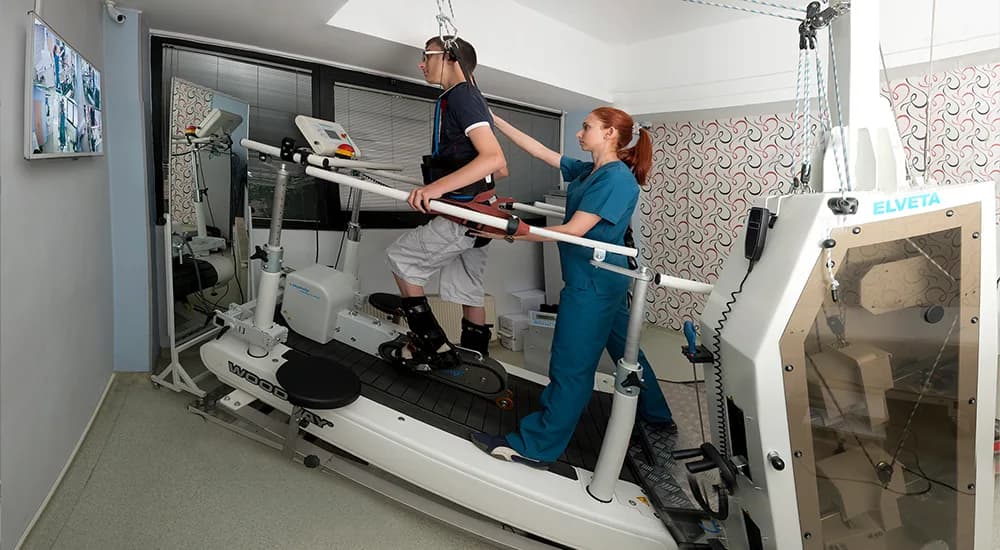
The patient is secured safely in the device with a special harness and vest. How much of the body weight the robot supports, and how actively the patient takes part, is decided by the physiotherapist for each session.
During the session the patient walks on a treadmill with robotic support. In end-effector systems the support comes from under the soles of the feet, while in exoskeleton systems the whole leg, including the hip and knee joints, is guided by the robotic frame. Virtual reality or visual feedback can run on the screen in front of the patient throughout the session. After each session the physiotherapist reviews the data recorded by the device and adjusts the support level, speed and duration for the next one.
Are There Differences Between Robotic Rehabilitation Systems?
There are two types of robotic rehabilitation systems: end-effector and exoskeleton. The robotic rehabilitation system at ROMMER Physical Therapy and Rehabilitation Center is an end-effector system, meaning the machine supports the last link of the kinematic chain — the foot.
Because the hip and knee joints are free in end-effector systems, the patient takes an active part in gait training. The patient moves together with the system and learns to use the right muscle at the right time. As a result, the patient walks sooner and with better gait quality. Since they allow active participation, end-effector systems give better results than other systems in relearning how to walk.
Unlike other robotic systems, the patient is supported by a two-point weight-bearing system, which provides better trunk stabilisation. The two-point system can work with symmetric, asymmetric, dynamic and static weight bearing at different loads, creating support that fits the person's needs. Among current robotic systems, only the Woodway Lokohelp Robotic Rehabilitation System has this feature.
Unlike many other systems, the Woodway Lokohelp system at our center allows gait training on different surfaces. The incline (ramp) setting lets patients practise walking uphill, the activity they usually find hardest. In this mode the muscles at the back of the leg are activated more.
Would You Like to Book an Appointment?
Our specialist team will create the most suitable treatment plan for you.
Contact Us